Mapping Pathways is a multi-national project to develop and nurture a research-driven, community-led global understanding of the emerging evidence base around the adoption of antiretroviral-based prevention strategies to end the HIV/AIDS epidemic. The evidence base is more than results from clinical trials - it must include stakeholder and community perspectives as well.

07 March 2012

CROI 2012: Researchers Present FEM PrEP Results

via MedPage Today, by Ed Susman
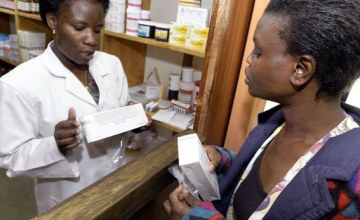
Pre-exposure prophylaxis with antiretroviral drugs failed to prevent women in Africa from becoming infected with human immunodeficiency virus (HIV) – apparently because more than half the women failed to take their medication.

The incidence of HIV infection among previously uninfected women treated with a co-formulation of emtricitabine and tenofovir (Truvada) was 4.7 per 1,000 person-years compared with a rate of 5 per 1,000 patient-years among women in the placebo group (P=0.81), said Lut Van Damme, MD, PhD, senior scientist at FHI 360, in Durham, N.C.

In a press briefing here at the Conference on Retroviruses and Opportunistic infections, Van Damme said it was likely that lack of adherence resulted in the failure to show a difference between those women on the active antiretrovirals and those who received placebo.

"The women in the study seriously overestimated adherence," she said. The participants told researchers that they took their assigned medicine 95% of the time. Pill counts indicated that 85% of the pills were not returned at regular points in the trial. But tests for emtricitabine/tenofovir in the blood of patients showed that only about 40% of the women had levels of the drug that would indicate the pills had been ingested within 48 hours of the tests.

The study was stopped early when an interim analysis showed that it was unlikely to prove positive.
The so-called FEM-PrEP was a randomized, double-blinded, placebo-controlled trial of once-daily oral emtricitabine/tenofovir. The primary effectiveness endpoint was incident HIV infection during 52 weeks of follow-up.

Participants attended screening, enrollment, and follow-up visits monthly. HIV seroconverters were taken off the product and followed for an additional 52 weeks

Read the Rest.


[Content that is linked from other sources is for informational purposes and should not construe a Mapping Pathways position.]

02 March 2012

Encouraging South Africans to Get Tested in Order to Seek Treatment

viaAllAfrica.com

When government made antiretrovirals (ARVs) available for people living with HIV/Aids, Grace Seopela grabbed the opportunity with both hands as she had a strong will to live and fight the virus.

Seopela, who is an HIV ambassador, has been living with HIV for the past eight years and is now encouraging South Africans to get tested as she has seen the benefits of taking treatment.

Speaking at the launch of the HIV Counselling and Testing (HCT) campaign on Friday at Eskom's construction site of the Kusile power station in Mpumalanga, Seopela urged employees to know their status as this would empower them to make critical decisions about their lives.

"If it wasn't for government, which gives us treatment, maybe I wouldn't be alive today... When the treatment was made available to us, I grabbed that opportunity and now I control HIV ..." Seopela said.
About 80 percent of Eskom employees got tested last year when the campaign was launched at Medupi power station in Limpopo. This week, Eskom continued with its campaign to get employees to know their status.

Health Minister Dr Aaron Motsoaledi was at Kusile today, where about 5 000 staff members got tested during the five-day campaign which started on Tuesday.
Chairperson of Eskom Holdings, Zoli Tsotsi, said the enthusiasm shown by staff members towards the campaign was encouraging, as 91 percent of Eskom employees now knew their HIV status.

Read the Rest.


[Content that is linked from other sources is for informational purposes and should not construe a Mapping Pathways position.]
01 March 2012

The Impact of the West on the AIDS Epidemic


viaNPRbooks

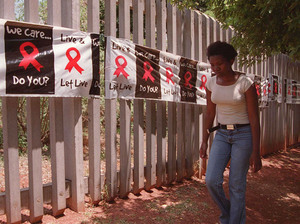
A woman walks past a banner placed around the perimeter of the Rand Afrikaans University in Johannesburg on World AIDS Day. The university used the banner to raise public awareness about AIDS and the devastating toll the disease has had in South Africa. HIV is a slow-moving time bomb.

Unlike Ebola, which infects and kills people quickly — and then disappears just as quickly — the HIV epidemic has become so good at killing people in part because it moves so very slowly, says journalist Craig Timberg.

"In vaginal sex, you can have sex with hundreds of people and not transmit [HIV], it turns out," he says. "And that's part of the reason it's still with us today. It has spread very slowly. It makes people ill very slowly. ... And that's one of the reasons why it's been so difficult for the world to understand it. ... It's been hard to make sense of this epidemic because of the way it moves. It's not obvious."

The History Of HIV

Timberg tells Fresh Air's Dave Davies that the simian version of HIV — which is called SIV — has been around for thousands of years. It was only when colonial powers migrated across parts of Africa — where the SIV virus existed among the chimps — that the virus started to spread among humans.

"It was only with the introduction of these new transport routes, of these human movements, that HIV popped out of the chimpanzee population and starts an epidemic among the human population and became what we see today," he says.

In the past 100 years, 99 percent of all of the world's deaths from AIDS have come from a strain of the virus called HIV-1 group M, which first appeared in remote parts of Cameroon, where African porters worked a century ago cutting paths across dense brush in places where humans had never before traveled.

"The best theory is that a human caught a chimp, was butchering a chimp — which is a very bloody business — and in the process of that cut his hand, and the virus mutated as it went into the human bloodstream," says Timberg. "... [There was] human movement in areas where humans didn't live in great density before colonialism arrived — you had the arrival of the rubber trade and the ivory trade, and suddenly you had to go into these very deep parts of the forest that were not hospitable to humans before and since."

From Cameroon, strains of HIV migrated down into other parts of central Africa and then into Leopoldville, which is now called Kinshasa. Leopoldville was a Belgian territory and by 1920 had become the capital of the Belgian Congo — complete with factories, shipyards, railways and single-sex dormitories for the workers, who were thrust into urban living conditions.

"You had the kind of human movement that could really get an epidemic moving," says Timberg.
In 1960, the Belgians gave up Congo, which then became an independent country again. At that point, 1,000 to 2,000 people likely had HIV, says Timberg.

"But you have to bear in mind, when HIV progresses into AIDS, it looks like a lot of other diseases," he says. "You have diarrhea, you have fevers, you have wasting. So there's not much evidence that anybody at the time had any evidence that there was a new sickness."

The unknowingly infected inhabitants of Kinshasa mingled with U.N. aid workers who were flown over from Haiti to work as physicians and civil servants. It is almost certainly the case, says Timberg, that one of the Haitian aid workers caught HIV in Leopoldville and then flew back to Haiti.

Fighting AIDS In Africa

In the 1980s in the United States, there was a large resistance to the idea that HIV and AIDS could spread widely among a heterosexual population — in part, says Timberg, because it didn't happen in many places. But across Africa, he says, it was a different story.

"The first researchers who began to look into the HIV epidemic in Africa found these unbelievable rates of infection that frankly horrified them and terrified them," he says. "When they began to write their papers about this, the peer-reviewed medical journals were like, 'You're crazy. You can't have HIV spreading like this.' But in Africa, it did."

Many African countries initially ignored the AIDS crisis, but some nations — like Uganda and Zimbabwe — were successful in providing public health information and slowing the spread of the disease. Timberg says when Western countries later became serious about fighting the African AIDS epidemic, international AIDS groups didn't follow Uganda's model — and overlooked some relatively simple and inexpensive approaches proven to stem the spread of HIV.

One of their errors, he says, was overlooking the effectiveness of male circumcision. Circumcised men are at a much lower risk of becoming infected with HIV through sexual transmission.

"When you look at the parts of not just Africa but the world where HIV is worse, it is almost inevitably societies that don't circumcise," he says. "The science on this began emerging in the 1980s and it became terribly politicized. People were uncomfortable with the subject, and the whole discussion became incredibly controversial. It took almost 20 years for the scientific community and the community of policymakers to really do enough science and enough research to realize how important this was."

Read the Rest.


[Content that is linked from other sources is for informational purposes and should not construe a Mapping Pathways position.]

29 February 2012

Positively Aware's HIV Drug Guide is a "Must Have"


16th Annual HIV Drug GuideThe Positively Aware 16th Annual HIV Drug Guide, widely recognized throughout the country as the “must-have” reference tool for HIV service providers and consumers alike, is now available.

There are now 30 FDA-approved HIV therapies to choose from, and finding the most effective and appropriate medication regimen is vital to success in treating HIV. The guide provides important information to individuals living with HIV as well as their caregivers on how best to manage their treatment.

This 80-page issue of Positively Aware devotes a full page to each approved HIV medication, plus four experimental medications, three of which are slated for approval later this year: the integrase inhibitors elvitegravir and dolutegravir (the latter now available through expanded access), the new upcoming single-tablet regimen known as the “Quad,” and the pharmaco-enhancer boosting agent cobicistat.

The pullout drug chart, sponsored by Walgreens, includes dosing information, as well as food and liquid requirements for the drugs, along with a photo to help easily identify each medication. Readers will also find detailed information on side effects, drug interactions, and current trends in HIV care and treatment.
This year’s guide also has an updated and expanded article on HIV drug co-pay and patient assistance programs being offered by pharmaceutical companies, including an easy to read chart, plus information on AIDS Drug Assistance Programs, Medicare, and Medicaid.

“It’s so critical that people know that there is help available when accessing and paying for treatment,” Positively Aware Editor Jeff Berry said. “There is no reason why anyone should be denied access to lifesaving medication based solely on an inability to pay for their drugs or co-pays, or because they cannot afford health insurance.”

One of the most popular features of the guide is the viewpoint given on each medication from a well-respected physician and an activist. Contributors to this year’s Drug Guide include Dr. Joel Gallant, professor of medicine and epidemiology at the Johns Hopkins University School of Medicine’s Division of Infectious Diseases, and associate director of the Johns Hopkins AIDS Service; activist Joey Wynn, director of public policy at Broward House in Fort Lauderdale, Florida; Renata Smith, PharmD, clinical assistant professor in HIV/infectious diseases at the University of Illinois at Chicago; and Associate Editor Enid Vázquez.

“Positively Aware’s Annual HIV Drug Guide is a great source for cutting edge treatment information, not only for those of us who prescribe these drugs, but for our HIV-positive patients as well,” Gallant said. “I was happy to be asked again to contribute to this year's edition — it’s always an enjoyable project.”

Positively Aware is an internationally known and respected magazine devoted to HIV treatment and health. It has a circulation of over 100,000, and is published bi-monthly by Test Positive Aware Network (TPAN). Founded in 1987, TPAN is Chicago’s oldest peer-led AIDS service organization and specializes in treatment information, support services, and prevention.

To order copies of the magazine, call (773) 989-9400 or distribution@tpan.com. For more information about TPAN and Positively Aware magazine visit tpan.com and positivelyaware.com.


[Content that is linked from other sources is for informational purposes and should not construe a Mapping Pathways position.]

British HIV Association: Revised Guidelines for Antiretroviral Therapy


altThe British HIV Association (BHIVA) has issued revised guidelines for antiretroviral therapy (ART) for adults and for pregnant women and prevention of mother-to-child HIV prevention. Comments are currently being accepted.

ART for Adults
 
The draft for adults includes guidance on starting ART in treatment-naive patients, supporting people on treatment, and managing people who experience virological failure. The guidelines also cover special considerations for specific patient populations.

The guidelines are available on the BHIVA website, which features an online form for comments, and published in the January 2012 issue of HIV Medicine. The deadline for feedback is March 5, 2012.

As described in an overview by Aidsmap, the revised guidelines recommend that clinicians should discuss with all HIV positive patients the growing evidence that effective ART reduces the likelihood of HIV transmission to sexual partners. However, evidence to date -- for example, recent findings from study HPTN 052 showing a 96% risk reduction -- mainly concerns heterosexual couples having vaginal sex.

Patients should be informed of the prevention benefits of ART even if they do not yet need treatment for their own health because their CD4 T-cell count has not fallen below 350 cells/mm^3.

Unlike the latest U.S. guidelines -- which raised the treatment initiation level to 500 cells/mm^3 -- BHIVA kept the 350 cells/mm3 threshold for most patients, though people with certain coinfections and other risk factors (e.g., hepatitis B or C, HIV-related kidney disease or neurocognitive impairment) may benefit from starting sooner.

BHIVA came down in favor of tenofovir/emtricitabine (the drugs in the Truvada combination pill) as the favored dual nucleoside/nucleotide reverse transcriptase inhibitor (NRTI) component of ART. U.S. guidelines also deem tenofovir/emtricitabine as the "preferred" NRTI combo, although the new European AIDS Clinical Society (EACS) guidelines rank tenofovir/emtricitabine and abacavir/lamivudine (the drugs in Epzicom) as equals.

BHIVA and the U.S. panel both demoted abacavir due to concerns about lower effectiveness for people with high viral load and elevated cardiovascular risk; tenofovir, however, has been linked to kidney impairment. All guidelines authorities agree that individual risk factors should be taken into account when selecting antiretroviral drugs.

BHIVA lists drugs in 3 classes as preferred third agents: the NNRTI efavirenz (Sustiva), the boosted protease inhibitors atazanavir (Reyataz) or darunavir (Prezista), and the integrase inhibitor raltegravir (Isentress).


[Content that is linked from other sources is for informational purposes and should not construe a Mapping Pathways position.]