Mapping Pathways is a multi-national project to develop and nurture a research-driven, community-led global understanding of the emerging evidence base around the adoption of antiretroviral-based prevention strategies to end the HIV/AIDS epidemic. The evidence base is more than results from clinical trials - it must include stakeholder and community perspectives as well.

Showing posts with label HIV/AIDS policy. Show all posts

01 April 2014

Mapping Pathways Launches NEW Report - "Community-driven strategies for the use of ARVs as prevention: United States Workshop Report"

The Mapping Pathways United States Workshop Report is launched today, providing the results of three HIV prevention scenario-development workshops held in 2013 in the United States.

The "Community-driven strategies for the use of antiretrovirals as prevention: United States Workshop Report" analyses, aggregates and synthesises different factors, issues, and drivers identified by workshop participants and constructs a future scenario for HIV prevention strategies using ARV (antiretroviral) drugs in the United States. Integration - of factors and systems involved in both treatment and prevention - is the main driver of success.

We hope you will read the report and utilize it in your organizational/jurisdictional planning processes for HIV prevention and care services. Please share the report with colleagues you think will be interested.

 In 2013, a subset of the Mapping Pathways team conducted knowledge-exchange workshops in San
Atlanta workshop participants
Francisco, Atlanta, and Washington, D.C., to further share the findings of our 2013 report ("Developing evidence-based, people-centred strategies for the use of antiretrovirals as prevention") and to continue enhancing the community-driven, locally informed approach to the wider evidence base for ARV-based prevention.

The cities were selected based on geographic diversity as well as the diversity of experience and expertise that can be found in each setting.

All three workshops included a mix of approximately 20 researchers, advocates, policy experts, public health officials, and service providers; they were diverse in terms of age, race, gender identity, sexuality, sero-status, and years in the field, with a blend of local to national experiences and perspectives.

Participants collaboratively developed a range of future scenarios and potential strategies linked to prevention programming goals and objectives. They were asked to think ahead to the year 2025, and envision an array of outcomes associated with the implementation of ARV-based prevention.

Based on participant ideas and concepts synthesised across all three workshops, we developed a ‘Mapping Pathways’ scenario for the future which has a strongly integrated approach at its core. The main driver of this future scenario is one of integration across political, economic, social, educational, and technological factors, and integration across the broader scientific, healthcare, and delivery systems. This means that we integrate both treatment and prevention strategies, including how we develop them, how we fund them, and how we deliver them, into one holistic approach.

Political and economic factors considered by workshop participants

The Mapping Pathways scenario was informed by these key themes common to all the workshops:

• Participants emphasised the need for a more holistic approach to HIV services in which prevention and treatment were not seen as mutually exclusive.

• Social and behavioral research must be supported and integrated with biomedical research.

• Digital web and device-based technologies and information sharing will affect access, uptake, and adherence.

• The Affordable Care Act (ACA) offers major opportunities for expanding access to healthcare, and poses challenges in HIV prevention and care delivery as the landscape evolves.

• Community-based organizations have a leading role to play in the new healthcare paradigm being ushered in with the ACA. They can help generate political will, drive research agendas, and deliver integrated care to communities and populations in need.

• Diversified funding streams are needed, and many of the optimistic scenarios generated by participants included strategies to engage a wide range of funders.

Click here for the United States Workshop Report.

[Please look for us on Facebook here www.facebook.com/MappingPathways and you can follow us on Twitter @mappingpathways as well.]

02 August 2013

IRIN Coverage of Mapping Pathways ARV-Based Prevention Report: “Here’s all this science - now what?”

via IRIN

 Excerpt:
According to Mapping Pathways, the ideal approach to implementing treatment as prevention should consider not only the clinical goal of efficacy (works in a lab), but also effectiveness (how to apply the solution in a community).

“I know that if you get anti-retroviral drugs into someone’s blood, they suppress the virus. We have amazing proof of that - it’s a major scientific breakthrough in the history of humankind,” said Linda-Gail Bekker, chief operating officer of the Desmond Tutu HIV Foundation, based in South Africa.

“But now we have to put this together so it works, which means engaging with a wide range of human beings who live very different lives than those of us who run these programmes might imagine,” she said.

Effectiveness requires behaviour change and, therefore, varies across cultures, governments, and communities based on “the firms that produce the drugs, the healthcare clinics that deliver the drugs, the community centres that provide education, and the partnerships developed,” according to Mapping Pathways.

“Human beings will behave like human beings. What does that mean? Well, social sciences have been trying to figure that out for centuries and don’t have one single theory, so why should our HIV programmes?” asked Bekker.

“The notion that in HIV programmes `one size fits all’ has backfired on us and it has been a humbling moment for those of us who work in this field.”

Read the whole article on IRIN.


[Please look for us on Facebook here www.facebook.com/MappingPathways and you can follow us on Twitter @mappingpathways as well.]

11 July 2013

NEW Podcast on the Promise of PEP, and the Unfortunate Lack of PEP Implementation


Jim and Jessica (pictured above) from the Mapping Pathways team are back with a new podcast - and this time the topic is PEP - post-exposure prophylaxis for HIV prevention.

This 12-minute podcast (click to listen) was produced by AIDS Foundation of Chicago (a Mapping Pathways partner) and is the third in a series of discussions inspired by the new report "Developing Evidence-Based, People-Centred Strategies for the Use of Antiretrovirals as Prevention."

In this new podcast,  Jessica Terlikowski and Jim Pickett discuss the promise of PEP, and the unfortunate lack of strong implementation that characterizes this intervention in nearly every part of the world.

Other podcasts

Click here for a previous podcast in which Jessica and Jim  introduce the Mapping Pathways report (published by Mapping Pathways partner RAND) and explain its relevance for multiple audiences. Click here for their second podcast where they chat about PrEP - pre-exposure prophylaxis.

Please stay tuned for future podcasts on topics like microbicides, the use of treatment for prevention, and more. Feel free to leave comments or questions here, on the podcast itself, of by sending an email to mappingpathways@gmail.com.

[ Please look for us on Facebook here www.facebook.com/MappingPathways and you can follow us on Twitter @mappingpathways as well.]

01 July 2013

Podcast: A Little PrEP Talk Inspired by New Mapping Pathways Report

This 10-minute podcast (click to listen) was produced by AIDS Foundation of Chicago (AFC) and is the second in a series of discussions inspired by "Developing Evidence-Based, People-Centred Strategies for the Use of Antiretrovirals as Prevention."

This new Mapping Pathways report was published 19 June 2013 by RAND Europe and AFC.

In this new podcast, AFC staffers and Mapping Pathways team members Jessica Terlikowski and Jim Pickett chat about PrEP - pre-exposure prophylaxis.

Click here for Jessica and Jim's previous podcast - posted June 21, 2013 -  which introduces the report and talks about why it is relevant for multiple audiences.

Keep your eyes and ears open.

Jessica and Jim will be back soon to talk about the other ARV-based prevention strategies that were explored in the report: PEP (post-exposure prophylaxis), TLC+ (testing, linkage to care, plus treatment) and microbicides. And you will find out about it right here.


[ Please look for us on Facebook here www.facebook.com/MappingPathways and you can follow us on Twitter @mappingpathways as well.]

21 June 2013

PODCAST: Mapping Pathways Team Talks About Our New Report on ARV-based Prevention

Snapshot of the global epidemic, highlighting India, South Africa and the U.S. where Mapping Pathways collected data. From the new report.
This 14-minute podcast (click below to listen) was produced by AIDS Foundation of Chicago (AFC) and kicks off a series of discussions about "Developing Evidence-Based, People-Centred Strategies for the Use of Antiretrovirals as Prevention" the new Mapping Pathways report published 19 June 2013 by RAND Europe and AFC.

AFC staffers and Mapping Pathways team members Jessica Terlikowski and Jim Pickett introduce the report and talk about why it is both interesting and useful.

Jessica and Jim will be back to talk more in depth about each of the ARV-based prevention strategies that were explored: PEP (post-exposure prophylaxis), PrEP (pre-exposure prophylaxis), TLC+ (testing, linkage to care, plus treatment) and microbicides. Watch - and listen - to this space!


Mapping Pathways Partners


Mapping Pathways Podcast: Intro by AIDSChicago

[Please look for us on Facebook here www.facebook.com/MappingPathways and you can follow us on Twitter @mappingpathways as well.]

20 June 2013

Mapping Pathways VIDEO: New Report's Lead Author Discusses ARV-based Prevention

90 Seconds: Molly Morgan Jones, a Research Leader in RAND Europe, and lead author of the new Mapping Pathways report "Developing Evidence-Based, People-Centred Strategies for the Use of Antiretrovirals as Prevention" discusses how antiretroviral (ARV)-based HIV prevention strategies need to be closely tailored to local contexts and cultures in order to make an impact on new HIV infections globally.

Watch below. Access the report here. Check out the report's Research Brief here.


[Please look for us on Facebook here www.facebook.com/MappingPathways and you can follow us on Twitter @mappingpathways as well.]

23 July 2012

AIDS 2012 Poster Presentations from Mapping Pathways - Check Them Out!

Original content from the Mapping Pathways blog team


[Pictured discussing the implications of the findings from the posters  are Georgina Caswell from GNP+ and Jessica Terlikowski and Molly Morgan Jones from the Mapping Pathways team.]

The Mapping Pathways project presented two posters at the AIDS 2012 conference on Monday, July 23. One was "Developing the evidence base for biomedical prevention strategies" and the other "Synthesising the empirical evidence to map pathways for HIV prevention planning."

Check out both posters below.


[Content that is linked from other sources is for informational purposes and should not construe a Mapping Pathways position. Please look for us on Facebook here www.facebook.com/MappingPathways and you can follow us on Twitter @mappingpathways as well.]

AIDS 2012 Slide Presentation: Exploring Strategies and Perspectives to Map Pathways for the Use of ARVs as Prevention

Original content from the Mapping Pathways blog team


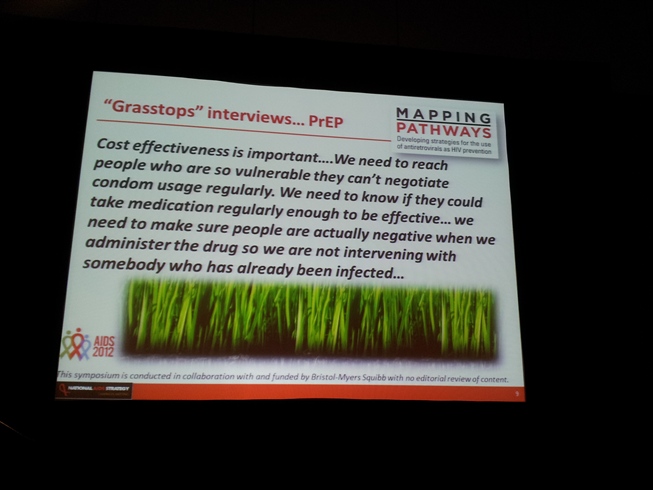
Molly Morgan Jones from RAND Europe - a Mapping Pathways partner - presented project findings specific to PrEP in the United States context at an AIDS 2012 satellite session this past Sunday, July 22. The satellite was called "From Revolution to Reality: How Will New Science Impact the U.S National HIV Aids Strategy?"

Please check out Molly's slides below.


[Content that is linked from other sources is for informational purposes and should not construe a Mapping Pathways position. Please look for us on Facebook here www.facebook.com/MappingPathways and you can follow us on Twitter @mappingpathways as well.]

19 June 2012

Mapping Pathways Community Perspectives on PrEP Webinar

Original content from the Mapping Pathways blog team

In response to recent news from the FDA regarding the use of the drug Truvada for prevention, Mapping Pathways U.S. partners AIDS United and AIDS Foundation of Chicago presented a webinar June 19 focusing on the ARV-based strategy PrEP (pre-exposure prophylaxis.)

During the webinar, key findings from the Mapping Pathways online survey and stakeholder interviews were presented to help illuminate the wide-ranging perspectives of advocates, clinicians, people living with HIV, policy makers and others regarding PrEP. While the U.S. context was highlighted, comparisons/contrasts were drawn with the opinions of individuals in South Africa and India.

Below are the slides from that webinar.


Click "slideshare" to download the slides if you wish.


[Content that is linked from other sources is for informational purposes and should not construe a Mapping Pathways position. Please look for us on Facebook here www.facebook.com/MappingPathways and you can follow us on Twitter @mappingpathways as well.]
31 May 2012

Developing multiple prevention strategies, Part II—In conversation with U.S.-Based Jessica Terlikowski

Original content from the Mapping Pathways blog team

“We need to ensure access to all forms of prevention and treatment is readily and easily available for anyone who needs it, so people can reduce their risk, get the prevention and care they need, reduce onward transmission and lead healthy lives.”


Jessica Terlikowski is director of regional organizing at AIDS United based in Washington, D.C. and was most recently a policy manager at the AIDS Foundation of Chicago. Both organizations are Mapping Pathways partners. Jessica is co-founder of the Chicago Female Condom Campaign, and coordinates the National Female Condom Coalition. She was recently honored by the AIDS Legal Council of Chicago  as “Advocate of the year” for outstanding work in making a difference in the lives of people with HIV and AIDS. 

 In part 1 of her interview, Jessica discussed the importance of scaling up interventions we know that work while moving forward with new strategies like PrEP. In part II of the interview, she discusses some of the challenges that have to be overcome in the HIV prevention landscape.

MP: In our previous conversation, you mentioned a lack of political will to invest in resources? Could you elaborate on that?

JT: In the United States, there are a number of state and federal lawmakers who are proposing deep cuts to health care, prevention, and other public assistance programs in the name of “fiscal responsibility.” They claim that by reducing the government’s spending on such programs, we can begin to turn the U.S. economy around. However, such cuts would be devastating to those of us who already struggle financially and have limited to no access to healthcare – the majority of people with HIV. Additionally, decimating health and social safety net programs results in higher future costs which simple doesn’t make good economic sense.

Federal funding for syringe-exchange programs has recently been banned once more, just two years after our Congress lifted a 21-year ban. These programs provide sterile syringes, male and female condoms, HIV and hepatitis counseling and testing, vaccinations, and many other lifesaving services to injection-drug users and their partners.  Syringe exchange is one of the most successful and cost-effective interventions we have. 

We’re in a situation now where we are getting conflicting messages from our leaders. On the one hand, we have Secretary of State Hillary Clinton saying, “we can have an AIDS-free generation “, while at the same time Congress is making decisions that undercut efforts to actually get us to that point.

MP: Why is the work that Mapping Pathways is doing important right now?

JT: Our work especially matters because we have a number of tools now and coming down the pike to stem the HIV epidemic. We have several strategies at our disposal including PrEP and TLC+. While the stakeholder interviews and community input sessions are hugely beneficial to us, they also inform, educate and create a discussion among the stakeholders and the communities they belong to.

Many people’s knowledge of ARV-based prevention strategies is limited. They also have a lot of questions and concerns. . We are creating a space for people to learn and to discuss each of the options and how they relate to each other. Mapping Pathways participants then communicate and discuss the broader issues with their own communities. This is something that we are working on now—the dissemination of the community and expert perspectives we collected in the first year of the project.

Mapping Pathways is also important here in the U.S. because HIV continues to be a big problem here that especially impacts people who are already marginalized: people with low incomes, gay men, transgender women and women of color, people who use drugs. These are communities whose needs must be prioritized if we are to reduce the number of new HIV infections.

Mapping Pathways is all about having conversations about ARV-based prevention strategies. We need to make sure that these strategies are not going to be reserved just for people who already have access to healthcare.  We need to ensure access to all forms of prevention and treatment is readily and easily available for anyone who needs it, so people can reduce their risk, get the prevention and care they need, reduce onward transmission and lead healthy lives.

MP: Is this possible in the U.S. context right now?

JT: It is, but it won’t happen overnight. AIDS is a social justice issue and not just a public health issue. We have to talk about many other issues when we talk about HIV, like sex, drugs, and poverty, which are not things many people feel comfortable talking about. Our job as advocates is to raise these issues with decision makers and educate and organize our communities to build the necessary political will.
  
MP: What is the most satisfying part of your job?

JT: I think the most satisfying part of my job is working with others who share a common passion and drive on these issues. We are all deeply committed to working with our communities to increase political will for greater investment in and attention on HIV prevention, treatment, and care issues.

Read the first part of Jessica’s interview here, and learn more about the Mapping Pathways learnings from the U.S. here. 


[Content that is linked from other sources is for informational purposes and should not construe a Mapping Pathways position. Please look for us on Facebook here www.facebook.com/MappingPathways and you can follow us on Twitter @mappingpathways as well.]

22 May 2012

Developing multiple HIV prevention strategies - In conversation with U.S.-based Jessica Terlikowski

Original content from the Mapping Pathways blog team

“We must build the political will for investment in each these HIV- prevention strategies”

Jessica Terlikowski is director of regional organizing at AIDS United based in Washington, D.C. and was most recently a policy manager at the AIDS Foundation of Chicago. Both organizations are Mapping Pathways partners. Jessica is co-founder of the Chicago Female Condom Campaign, and coordinates the National Female Condom Coalition. She was recently honored by the AIDS Legal Council of Chicago  as “Advocate of the year” for outstanding work in making a difference in the lives of people with HIV and AIDS. 

 MP: How did you get involved in the field of HIV prevention?

JT: I got involved in the field of HIV prevention through my commitment to women’s reproductive health and rights, which is where I got my professional start. I have been a staunch reproductive rights advocate ever since I can remember.  When I moved to Chicago, there was a position available at the AIDS Foundation of Chicago and microbicide education and advocacy education was a part of the job.  I didn’t have an in-depth knowledge of the field at the time and was eager to learn.  

 MP: Is there a prevention strategy that you are especially passionate about?

JT: I think the key is to have as many prevention strategies available as possible. I am, however, extremely passionate about female condoms as they are an important tool for any receptive partner—woman or man—to reduce their risk of HIV and other STDs. They are particularly important for women though as female condoms are the only HIV and STI prevention options that also prevents unintended pregnancies. The global South has recognized the value of this tool for quite some time and the U.S. is starting to get there now too. We are seeing more and more community based organizations, clinics and health departments prioritize female condoms as a result of increased advocacy from a handful of us. The U.S. female condom movement is growing and building momentum.

What I am really concerned about is making sure that people are aware of what prevention strategies exist, so they know what is out there and can access what they need when they need it. We owe it to the communities to push for both existing tools like male and female condoms, sterile syringes, PEP, as well as emerging biomedical tools like microbicides and PrEP.

MP: What Mapping Pathways activities have you and AIDS United engaged in recently?

JT: We adapted the analyses from stakeholder interviews and online survey the Mapping Pathways team conducted in 2011 and created a PowerPoint slide deck which provides  a strong overview of the Mapping Pathways methodology, definitions of ARV-based prevention terms and an overview of ARV-based prevention strategies (read more about the presentation here). We conducted community input sessions with stakeholders at the CDC’s National HIV Prevention Conference and with a number of stakeholders at and AIDS United convening of southern grantees.  

A key finding  was that when we talked about ARV-based prevention strategies, people’s minds would go straight to PrEP instead of thinking of the full portfolio of ARV-based prevention strategies—TLC+, vaginal and rectal microbicides, and PEP. We also learned that there is a real need for developing a common vocabulary around these options to ensure we are all talking about the same thing. At times stakeholders would interpret use the term “treatment as prevention” to refer to PrEP when it is actually referring to TLC+.

A major theme arising from the stakeholder interviews, the survey outcomes as well the community input sessions was that though people are excited about the possibilities of ARV-based prevention strategies as a whole, they are also concerned about how the vast majority of the people who need these options could pay for them.

MP: What are some of the issues, financial and otherwise, that keep coming up in the field of HIV prevention?

JT: I think one of the biggest issues that keep coming up is that of resource allocation. Many are asking where the HIV field can and should invest its resources in order to have the most impact. Since HPTN052, some say that we should pull resources from traditional prevention programs to invest in TLC+ and suggest that people don’t use condoms anyway. Others say that due to resource limitations, it simply isn’t feasible to get everyone who is HIV-positive on treatment.

The reality is that there is no magic bullet that is going to turn the tide on the epidemic in the U.S. or around the world.  We need as many options available as possible and we need to scale up the interventions that we know to work, including increasing availability to sterile syringes and male and female condoms, while also continuing to invest in research for emerging options ensuring that HIV-positive people who need treatment can access it. We can’t afford to play either/or here. Instead, we must build the political will for investment in each these strategies.

Check back next week for part II of the interview in which Jessica discusses ways we can make HIV prevention and treatment a reality for the people who need it most.


[Content that is linked from other sources is for informational purposes and should not construe a Mapping Pathways position.]

03 April 2012

Statements from New US AIDS Policy Director, Dr. Grant Colfax, Causes Mixed Reactions

via The Colorado Dependent, by Todd A. Heywood

With a president who has declared the end of AIDS is in reach, Dr. Grant Colfax has a massive job in front of him. But his first interview with The American Independent has some activists challenging his take on controversial elements of the epidemic impacting an estimated 1.2 million Americans.
The former director of the San Francisco Department of Public Health HIV programs was appointed by President Barack Obama to run the Office of National AIDS Policy (ONAP), March 14.

In a brief phone interview with The American Independent, Colfax praised the National HIV/AIDS Strategy (NHAS) and said he was looking forward to implementing the plan. NHAS was released by the Obama administration in July of 2010 and is the first time in the 30 year history of the epidemic that the federal government has developed a comprehensive plan to address HIV in the United States.

HIV-specific criminalization

A key segment of the plan calls for addressing HIV-related stigma and discrimination, including addressing the bevy of HIV-specific criminal state laws that activists have identified as stigmatizing.

“Certainly, criminalization is one of the issues we’ll be looking at as we engage stakeholders in a broader conversation about how stigma and discrimination are contributing to HIV risk and core health outcomes,” Colfax said.

Asked what his personal take on criminalization and its impact on the HIV epidemic was, Colfax demurred.

“I think it’s really premature for me to speak specifically about that beyond what I just said,” Colfax said.

That response did not sit will with activists.

“Dr. Colfax’s boiler-plate reaction to the criminalization issue is disappointing,” said Catherine Hanssens, executive director of the Center for HIV Law and Policy, which houses the anti-HIV criminalization group Positive Justice Project. “Prosecuting and incarcerating people with HIV for years and decades for consensual and no-risk conduct is a profoundly serious form of discrimination that has been stigmatizing people with HIV for decades.”

Sean Strub, a board member for the Global Network of People with HIV– North America, was also disappointed.

“To have any discussion about stigma that doesn’t start with removing HIV-specific criminal statutes is hollow,” Strub said. “Those statutes, which create a viral underclass, are the most extreme manifestation of stigma.”

Read the Rest.


[Content that is linked from other sources is for informational purposes and should not construe a Mapping Pathways position.]

The Impact 'The Affordable Care Act' Will Have on HIV Treatment and Care

via HuffPost Chicago, by Gregory Trotter

For the 1.2 million Americans living with HIV, the Affordable Care Act will be utterly life-changing. For some, it will be life-saving.

Just ask Will Wilson, 58, who was diagnosed with "full-blown AIDS" in 2002.
"It will basically mean freedom," said Wilson, a Chicago resident and an advocate for the Illinois Alliance for Sound AIDS Policy.

For the first time, Wilson will be able to purchase private insurance without fear of being rejected for his preexisting condition. The former graphic designer will be able to aggressively re-enter the job market without risking his continuous access to lifesaving HIV drugs that cost him $3,000 a month.

He'll have options he's never had.

This week, the Supreme Court has heard oral arguments on the constitutionality of the Affordable Care Act, specifically the legality of the individual mandate provision and the expansion of Medicaid. It is slated to rule in June on what is widely considered to be the most important Supreme Court case in decades. Many people living with HIV/AIDS and other preexisting conditions will be hoping and praying that the court rules in favor of health care reform.

In January, the AIDS Foundation of Chicago (AFC) signed on to a legal brief -- along with 130 other HIV/AIDS organizations throughout the country -- asserting that the Affordable Care Act is, in fact, constitutional. It's also necessary to stopping the AIDS epidemic in the United States.

"The list of supporters for our brief urging the court to uphold the ACA continues to grow because of the law's enormous potential to impact the domestic AIDS epidemic," said Scott Schoettes, HIV Project Director for Lambda Legal, the legal firm that submitted the brief.

About 24 percent of people living with HIV are uninsured, according to data from the U.S. Department of Health and Human Services. The majority of people living with HIV depend on Medicaid and Medicare for medical treatment.

Read the Rest.


[Content that is linked from other sources is for informational purposes and should not construe a Mapping Pathways position.]

14 March 2012

Dr. Grant Colfax is Appointed Director of White House Offices of National AIDS Policy Position

via PR Newswire

San Francisco AIDS Foundation applauds President Obama's selection of Dr. Grant Colfax to become director of the White House Office of National AIDS Policy. Dr. Colfax is uniquely suited to continue the momentum established under his predecessor, Mr. Jeffrey Crowley, in advancing the ambitious goals outlined in the president's National HIV/AIDS Strategy and moving us closer to an AIDS-free generation.

"Dr. Colfax has been instrumental in the decline of new HIV infections in San Francisco in recent years," said San Francisco AIDS Foundation CEO Neil Giuliano. "His unique blend of experience serving on the front lines of the epidemic, implementing the national strategy at the local level, working as a direct service provider within the Ryan White CARE system, and conducting cutting-edge research makes him the right person at the right time to lead the Obama administration's efforts to end HIV/AIDS in the United States."

The Office of National AIDS Policy provides essential leadership in addressing the U.S. HIV/AIDS epidemic. As director, Dr. Colfax will be required to take a fresh look at how resources can be targeted to reduce HIV infection rates, increase access to treatment, and decrease HIV-associated health disparities related to sexual orientation, race, gender, and socio-economic status in hard-hit communities across the country. His track record in San Francisco demonstrates he is well suited for this challenge.

"Dr. Colfax will play a critical role over the next several years to ensure the implementation of the Affordable Care Act and HIV service integration to address the health care needs of people living with HIV," said Ernest Hopkins, director of legislative affairs at San Francisco AIDS Foundation. "Having worked closely with him on complex issues and having seen his consensus-building skills among diverse populations, including communities of color, I am confident that the AIDS community will have a strong advocate within the administration. I know Dr. Colfax will work to ensure that the coming changes to our health care system are made thoughtfully, carefully, and with a strong focus on improving the health status of the most vulnerable people."

As director of the HIV Prevention and Research Section at San Francisco Department of Public Health, Dr. Colfax elevated the role of community-based health research in local planning and funding decisions and instituted innovative, evidence-based HIV prevention tools, such as measuring and mapping community viral load and enhancing HIV testing and linkage to care, making San Francisco's HIV prevention planning and service system a model for jurisdictions across the nation. When developing the city's most recent HIV prevention plan with diverse stakeholders, Dr. Colfax was mindful to ensure its consistency with the emerging National HIV/AIDS Strategy. Throughout his career, he has maintained his role as a physician at Ward 86 at San Francisco General Hospital, the nation's first HIV/AIDS-specialized clinic.

San Francisco AIDS Foundation stands ready to work with Dr. Colfax, the White House, and other community partners across the country to reduce new HIV infections, increase access to care for all people living with the disease, and reduce HIV-related health disparities.


[Content that is linked from other sources is for informational purposes and should not construe a Mapping Pathways position.]

19 December 2011

The Treatment Action Campaign (TAC) Shapes AIDS Policy in South Africa

via The Guardian, by Pierre de Vos

boy hiv medication south africa
"The TAC case thus illustrates how social and economic rights can be used by civil society groups to mobilise public support for a worthy cause – even before a court is asked to adjudicate on what will often be very complex legal and moral issues – and that it can enhance democratic engagement and participation."

Shortly after Thabo Mbeki, the former South African president, began his flirtation with Aids dissidence in 2000, the Treatment Action Campaign (TAC) was created to respond to the HIV crisis in the country and the government's reluctance to deal with it.

Although closely aligned with the ANC government, the TAC engaged politically and launched various court challenges to force a change of heart on the part of the government and, ultimately, in order to ensure that every HIV-positive person who could not afford it was provided with antiretroviral (ARV) medicine by the state.

The TAC ran a brilliant and strategically astute campaign to mobilise the public, trade union organisations and other civil society groups behind its cause. Its trump card in this campaign was section 27(1) of the constitution , which states that everyone has the right to have access to healthcare services, including reproductive healthcare.

Like other social and economic rights contained in the South African bill of rights – including the right of access to housing, sufficient food and water; and social security – the right to healthcare is not absolute. It requires the state only to take reasonable legislative and other measures, within its available resources, to achieve the progressive realisation of each of these rights.

At the time of the drafting of the bill, some politicians and academics opposed the inclusion of these rights, arguing that it would not be possible for judges to enforce these claims as they would be required to make policy choices best left to the democratically elected branches of government. But given the vast discrepancies in wealth – often based on race – caused by apartheid and the fact that many citizens did not have access to basic services at the dawn of democracy, the drafters of the constitution believed that it was imperative to include not only traditional civil and political rights in the constitution, but also justiciable social and economic rights. Otherwise the very legitimacy of the constitutional enterprise would be at risk.

South Africa's constitutional court at first dealt cautiously with the interpretation and application of these rights, making it clear that it would not be feasible to interpret the rights in a way that provided individual claimants with a right to demand specific goods and services from the state.

The court was in a difficult position as it had to respect the separation of powers doctrine and could not dictate to the government how to allocate its budgets. At the same time it was required to ensure that the social and economic rights did not remain rights on paper alone, but were interpreted in a way that signalled their enforceability.

Read the rest.


[Content that is linked from other sources is for informational purposes and should not construe a Mapping Pathways position.]

05 December 2011

Mapping Pathways presents two posters at ICASA 2011 in Addis Ababa

Original content from our Mapping Pathways blog team

On December 5 Molly Morgan Jones and Jim Pickett from the Mapping Pathways project (left, top picture) presented two posters on our findings at the ICASA 2011 conference taking place now (through December 8) in Addis Ababa, Ethiopia.

The world has made great progress in fighting HIV/AIDS since the late 1990s. While incidence rates in sub-Saharan Africa have fallen, most of the world's new infections still occur there. A portfolio of approaches – or 'pathways' – to prevention is needed. Recent trial data shows great promise in four antiretroviral (ARV) prevention strategies.

The Mapping Pathways project used four separate methodologies to access diverse stakeholder perspectives and assess the evidence base, looking specifically at South Africa, India and the USA. 

We employ an adaptive approach to policy development around ARV-based prevention strategies. The project has engaged various stakeholders from India, South Africa and the United States in surveys, interviews and iterative exchanges to understand local perspectives and the empirical evidence needed to develop appropriate policy pathways for different contexts.

What will these pathways look like, how do we navigate them and where will they lead?

Please check out our posters - below - to learn more. And let us know what you think. You may leave a comment here, or send us an email at mappingpathways@gmail.com.


[Content that is linked from other sources is for informational purposes and should not construe a Mapping Pathways position.]

21 November 2011

How to get to zero: Faster. Smarter. Better - UNAIDS World AIDS Day Report 2011


[Content that is linked from other sources is for informational purposes and should not construe a Mapping Pathways position.]

16 November 2011

Secretary Hillary Clinton on Creating an AIDS-Free Generation: Bouquets and Brickbats

* Original content from our Mapping Pathways blog team

“An AIDS-free generation would be one of the greatest gifts we could give to the future.Let's make it happen.”

On November 9, US Secretary of State Hillary Clinton delivered a speech on HIV/AIDS at the National Institutes of Health in Bethesda, Maryland – a speech that has triggered mixed reactions from people in the HIV/AIDS treatment and prevention field. Take a look at some excerpts:

“Today we are making major investments in the search for a vaccine; for tools like microbicides, which give women the power to protect themselves; and other lifesaving innovations.”

“… our efforts have helped set the stage for the historic opportunity the world has today: to change the course of this pandemic and usher in an AIDS-free generation.”

“… creating an AIDS-free generation has never been a policy priority for the United States Government until today, because this goal would have been unimaginable just a few years ago … It requires all of us to put a variety of scientifically proven prevention tools to work in concert with each other.”

“America's combination-prevention strategy focuses on a set of interventions that have been proven most effective: ending mother-to-child transmission, expanding voluntary medical male circumcision, and scaling up treatment for people living with HIV/AIDS.”

“… we now know that if you treat a person living with HIV effectively, you reduce the risk of transmission to a partner by 96 percent.”

“Treating HIV-positive people before they become ill also has indirect economic benefits.It allows them to work, support their families, and contribute to their communities; and it averts social costs, such as caring for orphans whose parents die of AIDS-related illnesses … In other words, treating people will not only save lives – it will generate considerable economic returns too.”

“… we need to let science guide our efforts. Success depends on deploying our tools based on the best available evidence.”

“An AIDS-free generation would be one of the greatest gifts we could give to the future. Let's make it happen.”


A number of HIV/AIDS activists have applauded Clinton’s “bold” speech, pointing out her emphasis on the prioritization of the fight against the epidemic, her focus on scientific evidence, and her call for immediate action to take advantage of the “historic opportunity” to create an “AIDS-free generation.” Many hope that this kind of public statement will help boost activism to preserve domestic and international funding.

On the other hand, while Clinton mentioned vaginal microbicides for women, she failed to talk about pre-exposure prophylaxis (PrEP) and rectal microbicides. These two prevention strategies are meant to protect uninfected people from the HIV virus – they have been the subject of numerous recent trials, with substantial success being demonstrated in many of them. (Take a look at our blog post on some of these studies.) Some feel Clinton’s decision give these new prevention technologies a miss can be attributed to political, financial, and social reasons.

“The omissions were disappointing but not surprising,” says Jim Pickett, Director of Prevention Advocacy and Gay Men's Health at the AIDS Foundation of Chicago, chair of International Rectal Microbicide Advocates (IRMA), and a member of the Mapping Pathways team. “Her audience was international, which means predominately heterosexual, so I suppose it made strategic sense that she would steer clear of PrEP, which has been shown to be effective for gay/bisexual men but has produced conflicting results for heterosexuals. Nonetheless, with gay men and other men who have sex with men experiencing catastrophic rates of HIV the world over, it remains disturbing to me that this group was not even mentioned, whether in conjunction with PrEP or not.”

Another possible reason for the omission of PrEP is the fact that the global jury is still out on the feasibility of rolling out PrEP interventions while there are HIV-infected people who do not have access to treatment – a problem made all the more complex because of the crippling HIV/AIDS funding constraints over the last few years. However, Pickett firmly believes that the either/or stance taken by those nixing promising preventive technologies is dangerous and close-minded. “We’re continually working to get enough information and data to answer the big questions we’re grappling with – questions about efficacy, accessibility, funding, prioritization, and acceptability. These questions are extremely challenging, but it’s imperative that we work on solving them,” says Jim. “It’s not an option to stick our head in the sand. To turn the dream of an AIDS-free generation into a reality, it is absolutely clear that we must expand access to effective ARV drugs for all those who need them – whether they are HIV-positive or HIV-negative.”

To know more about Secretary Clinton’s speech and the responses to it, read the AIDS Foundation of Chicago’s story and Science Magazine’s article. You could also check out this letter to Secretary Clinton – a blog post written by an IRMA member.

You can read the entire speech here.


[Content that is linked from other sources is for informational purposes and should not construe a Mapping Pathways position.]

13 September 2011

The Latest Treatment Action Campaign (TAC) Briefing - Antiretrovirals and Prevention


Exciting new evidence has demonstrated the potential of antiretroviral medicines (ARVs) to prevent HIV from being sexually transmitted. This TAC briefing explains the evidence and then discusses policy implications. 


Our recommendations

  1. The WHO must release its guidelines on serodiscordant couples.
  2. People living with HIV should be offered highly active antiretroviral treatment (ART) when their CD4 counts fall below 350 cell/mm3, or if they have an AIDS illness or TB.
  3. HIV-positive people in serodiscordant couples should be offered ART irrespective of their CD4 count.
  4. For serodiscordant couples trying to conceive, both partners should be offered ARVs until conception is confirmed, after which the HIV-positive partner should continue on ART.
  5. Pre-exposure prophylaxis (PrEP) should be made available to sex workers.
  6. In other cases, pre-exposure prophylaxis should be made available to HIV-negative people who request it or who will --in the opinion of their nurse or doctor-- likely benefit from it.
  7. The rollout of ARVs for prevention must not divert funding away from treatment programmes. Achieving universal access for people with HIV must remain the priority for governments, policy makers and funders.
  8. Effective prevention interventions such as voluntary medical male circumcision and ensuring availability of male and female condoms continue to be critically important.

[Content that is linked from other sources is for informational purposes and should not construe a Mapping Pathways position.]